UKAEA’s centre for Remote Applications in Challenging Environments (RACE) is making strong progress with its Remote Handling Training Course. This follows successful deliveries in September 2025 and March 2026.
The course provides managers, designers and operators with a practical understanding of remote handling operations. This is an essential capability for the future of fusion energy, from the decommissioning of the Joint European Torus (JET) to maintaining future power plants. These skills are increasingly in demand across high-hazard industries, where remote operations improve safety, efficiency and reliability.
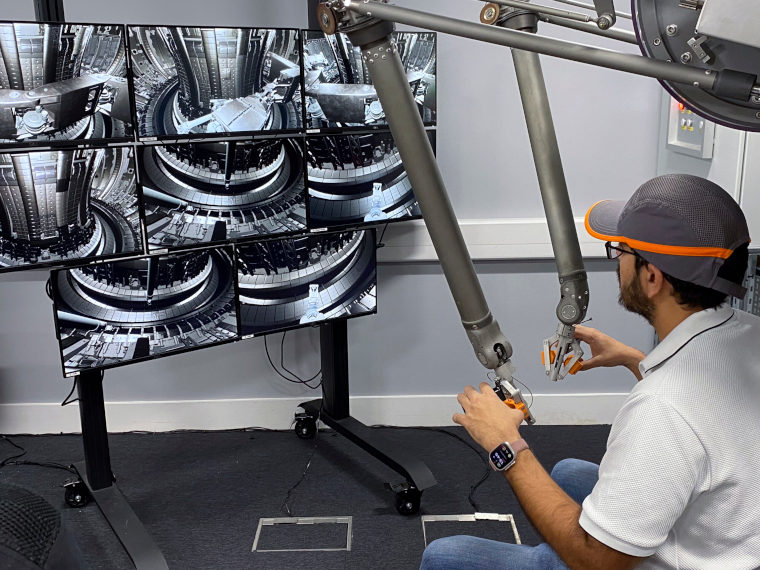
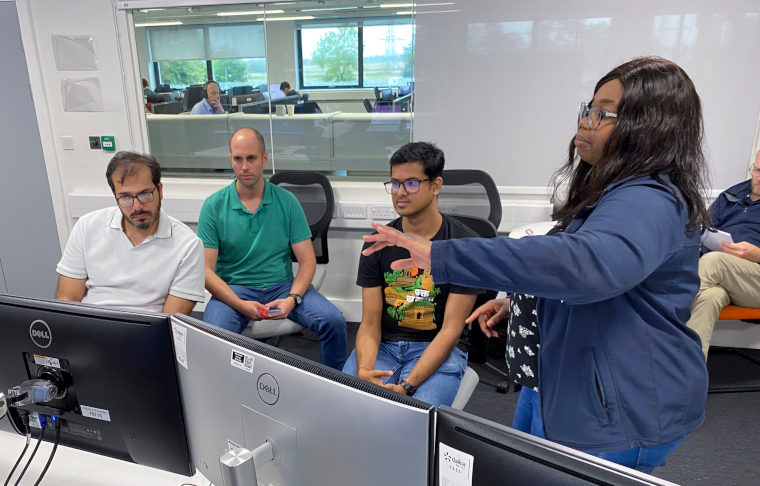
Drawing on decades of expertise at RACE, the four-day course combines technical insight with hands-on learning. Participants explore:
- system design and specification
- principles of safe and effective tool design
- software infrastructure for efficient operations
- strategies for reducing risk in high-consequence environments
The programme addresses the people, processes and organisational factors required for successful remote operations, alongside the role of plant design in enabling maintainability.
A defining feature is its strong focus on practical experience. Participants take part in immersive sessions in the RACE work hall, working directly with advanced technologies not widely accessible elsewhere. These include:
- precision manipulator systems
- haptic-enabled robotic arms with force-feedback capability
- mobile platforms such as the quadruped robot Spot for inspection in complex environments
Attendees engage with Next-Generation Digital Mock-Ups developed through the LongOps project. This supports applications like Fukushima Daiichi decommissioning.
The first two courses attracted a strong, diverse and international cohort from across industry and research. It spanned nuclear, robotics, engineering design and operations. Feedback has been highly positive. It has highlighted technical depth and practical value:
A good overview of the topic and an insight into the depth of the field.
The fundamentals helped to give context to the hands-on experiences, so we were better able to understand how the systems were designed, as well as their limits and capabilities.
Beyond technical learning, the course is helping to build a growing cross-sector network of professionals tackling complex, real-world challenges.
Building on this progress, the course is helping organisations develop the skills needed to deliver safe, efficient remote operations. It assists strengthening capability pipelines and fostering cross-sector collaboration. The course contributes to the skills, technologies and partnerships required to deliver fusion energy. The Fusion Opportunities in Skills, Training, Education and Research (FOSTER) programme has supported it. FOSTER aims to build the talent needed for the future fusion workforce.
The next course will take place from 14 to 17 September 2026.
You can contact the team with any questions.
Note: specific equipment and technologies during training may vary between courses.