Four British universities have expanded their provision of fusion tuition at Master’s level thanks to the public investment from the Department for Energy and Net Zero (DESNZ) and the UK Atomic Energy Authority’s (UKAEA) skills team through the Fusion Opportunities in Skills, Training, Education and Research (FOSTER) programme.
The FOSTER programme has committed to channel £40 million of government funding to support increased access into the growing fusion sector. It will deliver the provision of more generalist and specialist training across the educational spectrum to provide a future talent pipeline for fusion and STEP.
A key project has been the growth of fusion taught at Master’s level. Collaborations have recently been formed with the universities of Bath, Edinburgh, Swansea and York.
Fusion is undergoing significant evolution and expansion with higher levels of government and private sector investment. These courses aim to increase the number of highly qualified people to work across a range of disciplines throughout the sector.
Master’s launching September 2026
University of Bath
New fusion modules will be available via the following courses:
- 4-year MEng Chemical Engineering
- MSc Sustainable Energy Engineering
University of Edinburgh
New fusion modules will be available via the following courses:
- MSc in Particle and Nuclear Physics
- MSc in Mathematical Physics
- MSc in Theoretical Physics
- MSc in Applied and Computational Mathematics
Swansea University
Entirely new course launched: MSc in Fusion Engineering
University of York
Significant updates made to the well-established existing course: MSc in Fusion Energy Science and Technologies.
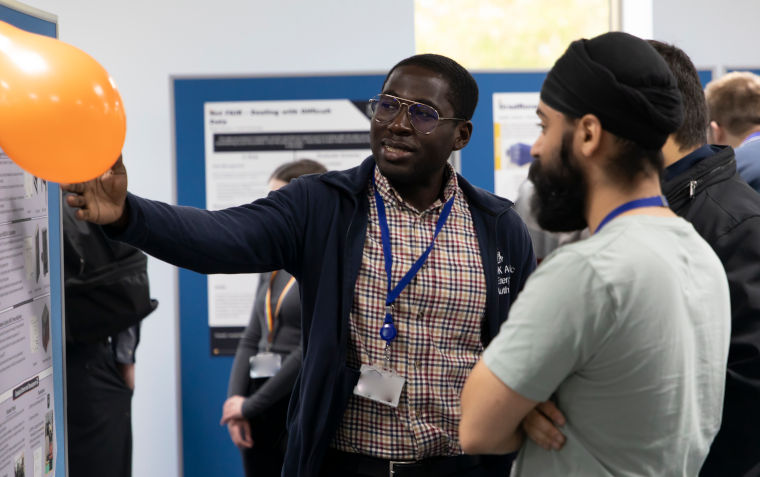
Supporting students into fusion energy careers
Each of the four universities has matched FOSTER’s investment to create an impactful provision for prospective students. Interventions are tailored to the strengths of each university and the skills required for future fusion careers. Activities include:
- recruiting new teaching staff
- provision of UKAEA technical expertise
- establishing scholarships and bursaries to improve accessibility
Outreach plays a key part in the collaborations. Work is underway to engage undergraduate students and create public resources to learn more about fusion energy.
Over the next four years, the UKAEA skills team will also invest in doctoral capability through:
- the Fusion Engineering Centre for Doctoral Training
- support for Fusion Power Centre for Doctoral Training students
- university collaborations
- scholarships
- wider higher education partnerships
These investments are strengthening the talent pipeline and expanding opportunities for students, researchers and employers across the sector.
Hayley Taylor, Skills Team Programme Manager, UKAEA said:
Master’s courses provide an essential bridge between undergraduate and doctoral studies or employment. Historically fusion has been underserved at this level, which made expanding this provision a key focus of the FOSTER Programme.
Working with the universities to establish these collaborations and create teaching content that is directly relevant to the growing fusion industry has been rewarding. We are looking forward to these courses continuing to develop over the next few years, ensuring that students with an enthusiasm for fusion have a clear route into doctoral research or fusion careers.
Huw Davies, Head of Skills for Fusion, UKAEA said:
These postgraduate programmes will support us in delivering future talent for STEP as well as the broader fusion industry that is growing at pace. The great news is that the courses now exist and more shall follow. But the sector is evolving quickly, so we need to attract and engage with universities, undergraduates and employers to raise awareness about these courses and entrench them as credible pathways into the fusion sector.
The new and updated provision complements existing Master’s courses at Imperial College, London (Physics with Fusion and Plasma Physics), Birmingham (Materials in Fusion Energy) and Bristol (Nuclear Science and Engineering).
Other academic projects supported by FOSTER as part of the programme’s overall goal of creating 2,000 new training opportunities within fusion include:
- Fusion Engineering Centre for Doctoral Training – delivered by the universities of Manchester, Sheffield, Liverpool and Birmingham
- Fusion Power CDT – delivered by the universities of York, Durham, Liverpool, Manchester, Oxford and Sheffield (Fusion CDT) – recruitment is underway for the next cohort of PhD students
- Industrial Visiting Academic Scheme, which provides funding to support UK universities to work with industry professionals to enhance student learning
- Undergraduate Webinar Series across a range of scientific and technical challenges being faced by the fusion sector