- JET continues to provide unique insight into how to design a fusion power plant
- tritium and materials science, remote handling and engineering combine in early phases of world-first research
- the impact of high-powered plasmas and groundbreaking experiments revealed
- remote handling technologies proven as UKAEA demonstrates world-leading robotics capabilities
- analysis of tiles and components will inform planning for future JET decommissioning activities
UKAEA has successfully developed and deployed remote handling technologies as part of the decommissioning of the Joint European Torus (JET). JET continues a 40-year legacy of world-leading research and development with the characterisation and analysis of materials. These include beryllium, tungsten and Inconel. It helps further inform and enable a sustainable fusion energy sector.
JET plasma science operations concluded at the end of December 2023. This began a transition into the JET Decommissioning and Repurposing programme (JDR), scheduled to last until at least 2040.
UKAEA has committed to decommission JET in a sustainable manner. It will use the programme as a showcase for technologies that are applicable both in fusion and adjacent sectors.
A critical early project has been the sample retrieval campaign. 66 tiles and components were removed from JET in 2024. They are now being processed and studied to assess the key physical, chemical and radiological properties of the materials. The results will help inform how JET is decommissioned.
The recovered tiles and components give an indication of the impact of years of high-powered plasmas on plasma-facing components.
Scientists looked to improve their understanding of damage mechanisms during JET’s final pulses. This included multiple intentional plasma disruptions and the associated electromagnetic forces, and aiming electrons at JET’s inner wall. By purposely creating these conditions they could see surface melting and the reverse waterfall effect. This provides unique insights that will assist in mitigating these issues in future fusion machines.
Experts from UKAEA’s Tritium Fuel Cycle and Materials divisions, and EUROfusion laboratories across Europe will analyse samples further. This is part of ongoing multi-national research programmes.
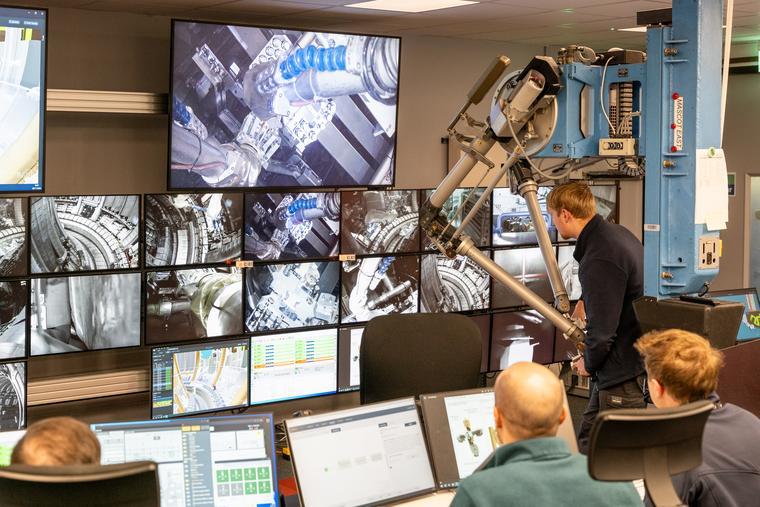
At the same time, UKAEA will upgrade its remote handling system to deliver the first phase of in-vessel decommissioning. It will remove around 3,700 components from JET.
A full upgrade of JET’s operating booms began in 2019. This upgrade included the installation of the Remote Handling Operations Virtual Reality (RHOVR), which harnesses the Unreal Engine. Better known for its use in video games, this creates hyper-realistic 3D environments. Other decommissioning programmes use it, including at Sellafield.
The Sample Retrieval operation was a huge success, demonstrating new capabilities and technologies. The team, which included newly trained operators, deployed the remote handling system, removing over 60 samples from the vessel. In addition, a collaboration with EUROfusion to carry out LIBS experiments – Laser Induced Breakdown Spectroscopy – gives us another view of the material properties in the vessel that will help for the future planning of JET decommissioning and take fusion science forward.
Steve Gilligan, Engineering Integration Manager, JET Decommissioning and Repurposing, UKAEA
We ran the tokamak quite ferociously up until the end of its operations, pushing scientific boundaries and breaking records in the process. This all affects materials. The Sample Retrieval programme removed some of our most interesting and complex materials and undertaking experiments or analysis on these materials gives an indication of what the rest of the tokamak system will look like. It gives us a good opportunity to benchmark all of our predictive models, and to plan for full-scale decommissioning.
Lewis Simmons, Lead Waste Engineer, JET Decommissioning and Repurposing, UKAEA
In addition to LIBS, in 2023 UKAEA also developed and implemented Laser Induced Desorption with Quadruple Mass Spectrometry (LID-QMS). This is a method of measuring the adsorption of tritium and other elements onto tiles and components inside the JET vessel using high powered lasers.
LID-QMS and LIBS are techniques that are being developed now for the use in future fusion power plants, that will allow us to monitor in real-time, or near-real-time, the dynamics of accumulation of fuel within the material of the wall. The studies of samples removed from the JET vessel will be used in order to support the development of these techniques. This is a complicated process and will involve the labs that have previously worked with JET components and will be doing so in the future.
Yevhen Zayachuk, Plasma Materials Surface Scientist, UKAEA