
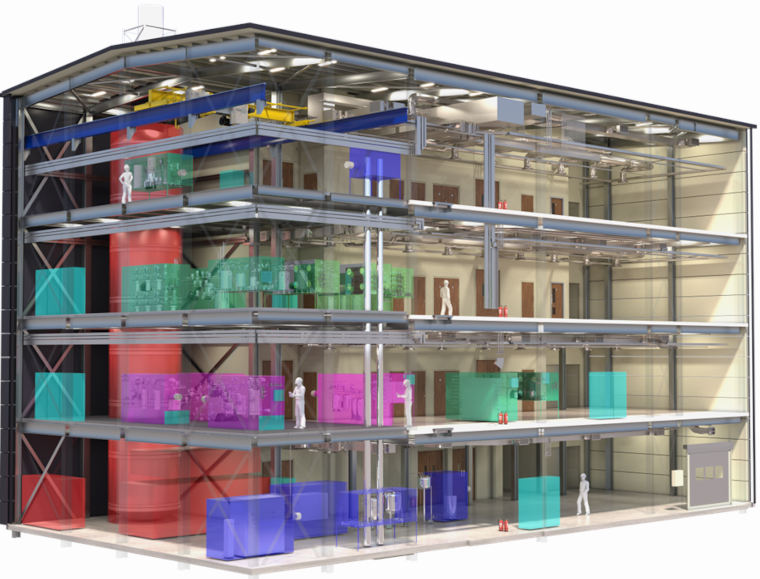
In 2025 UKAEA and energy giant, Eni, announced the development of the H3AT Tritium Loop Facility at Culham Campus.
Successfully managing tritium and fusion fuel will be critical for fusion power plants of the future. Tritium is a scarce resource. It is therefore essential that efficient and comprehensive processes are in place to recover tritium for reuse as fuel within a tokamak.
UKAEA’s expertise in tritium management, science and technology, and Eni’s world-leading experience in building, commissioning and operating large power plants, creates a powerful integrated team to successfully deliver the programme.
The UKAEA-Eni H3AT Tritium Loop Facility will demonstrate the operation of a continuous, closed loop fusion plant fuel cycle at a pilot power plant scale. It will be a world-leading user facility, and potential industry and academic users are welcome to engage with the UKAEA-Eni H3AT Tritium Loop Facility team.
Fusion energy promises to provide a low carbon, clean source of energy, aiming for commercialisation in the second half of this century. Fusion reactors generate energy by fusing together combinations of hydrogen atoms, mimicking the process that happens in stars.
The vast majority of fusion devices use two types of hydrogen isotopes, deuterium and tritium, as fuel because this reaction requires the lowest energy to initiate the fusion reaction whilst delivering a high energy output. When these isotopes of hydrogen are in the fuel cycle, they bond together to form molecules that contain any combination of the different isotopes. These combinations are referred to collectively as ‘isotopologues’.
The H3AT Tritium Fuel Loop will provide invaluable insight and critical data for the development and design of future fusion power plants.
The facility will also be a user facility, allowing innovative tritium technology testing and validation. This ensures tritium capabilities reach higher technology readiness levels, therefor making efficiency and cost savings for future facilities.
The UKAEA-Eni H3AT Tritium Loop Facility is planned to be completed in 2028 and fully commissioned and operational by 2030.
H3AT Tritium Loop Facility subsystems
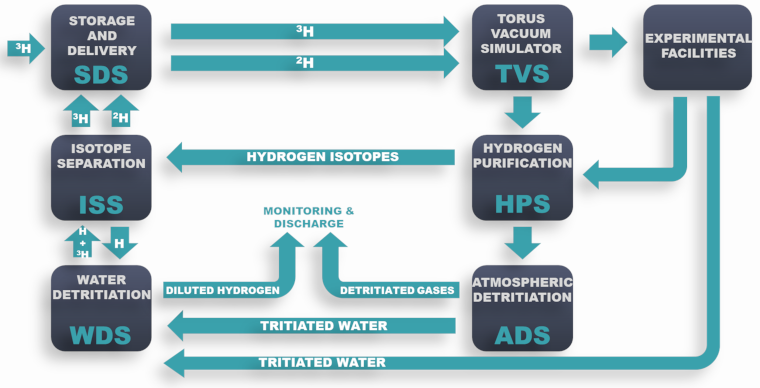
Storage and Distribution System (SDS)
Providing safe storage of hydrogen isotopologues, and their distribution to the tritium loop and experimental facilities.
Torus Vacuum Simulator (TVS)
A system of valves, tanks, pumps and controllers that enables simulation of fusion device feed and exhaust gas profiles.
Hydrogen Purification System (HPS)
Using a cascading series of Palladium Membranes and Palladium Membrane Reactors, tritium and other hydrogen isotopologues are recovered from the simulated exhaust stream. Hydrogem is passed onto the ISS, and the rest of the exhaust stream passes onto ADS.
Isotope Separation System (ISS)
Purification of mixed hydrogen isotopologues into pure gas products that can be returned to storage and distribution for use in further experiments.
Cryogenic system
Hydrogen isotopologues are separated using cryogenic distillation. This requires temperatures between 21-26K (~-250oC) to produce high-purity products and is achieved using cryogenic gaseous helium.
Ambient system
Gloveboxes house the ambient systems of pumps and reactors that enable high-purity streams to be produced from the feed mixtures.
Atmosphere Detritiation System (ADS)
Recovery of tritium from gas waste streams to minimise release to atmosphere, and collect the tritium and return it to the core loop
Water Detritiation System (WDS)
Recovery of tritium from tritiated water, primarily from ADS. Tritium and other hydrogen isotopologues are then fed into ISS.
Analytical Systems (ANS)
Cutting edge detectors determine the atomic and molecular composition of all the systems in the facility.