Our multi-skilled team can support all stages of fabrication, construction, inspection, and quality assurance, ensuring compliance with applicable industry standards and client requirements.
Manual welding
Coded manual welding
- Tungsten Inert Gas (TIG)
- Manual Metal Arc (MMA)
- Metal Inert Gas (MIG) / Metal Active Gas (MAG)
Semi-automated welding and orbital welding
- Enclosed orbital (autogenous) size range 2mm to 25 mm
- Open head orbital (wire feed capable) size range 25mm to 114mm
Inspection
- Radiographic interpretation
- Metallographic sample preparation and analysis
- X-ray flourescence (XRF)
- Dye penetrant inspection (DPI)
- Magnetic particle inspection (MPI)
Electron-beam (EB) welding
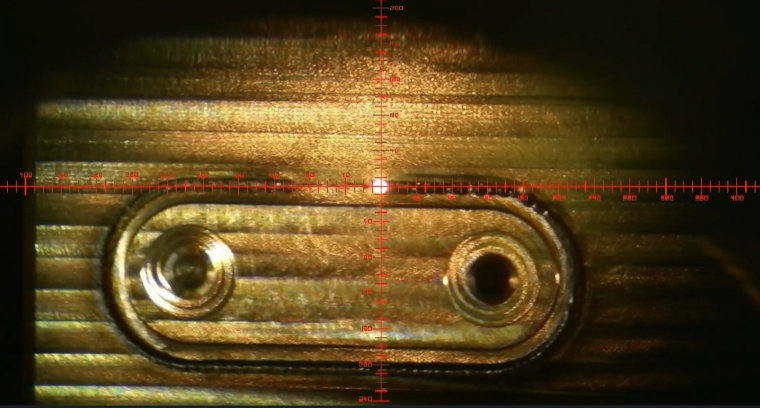
Electron-beam (EB) welding involves the joining of two metals by using a focused electron beam in a clean vacuum environment. This is typically with no additional filler metal.
EB weld benefits
Process benefits include:
- consistency – most parameters of the weld are automated to ensure consistency batch to batch, and the entire assembly is processed in a vacuum environment
- low distortion – the focused beam produces a weld ~1mm in size, with key-hole penetration profile into the material, thereby melting only the local joint area and minimising stress
- versatility – the localised heating means that welding can take place on assemblies which include sensitive materials such as ceramics and polymers
Weldment design
Successful weldment design depends upon:
- joint geometry
- planning for weld tooling
- requirements for post-weld inspection e.g. radiography
Contact our experienced team at the earliest stage of design to get the best end results.
We develop novel welded solutions for fusion challenges, but also supply components to imaging, beam-line, and aerospace customers.
Our welded components are on the surface of the duck-shaped comet 67P. This is several million miles from Earth, having landed as part of the Rosetta mission. Our Special Techniques Group (STG) continues to provide bespoke components for many similar demanding applications.
Industry standards we follow
BS EN ISO 5817
BS EN ISO 5817 is an international standard we follow, specifying quality levels for imperfections in fusion-welded joints made of steel, nickel, titanium, and their alloys. It defines acceptance criteria for visual and non-destructive testing, serving as a benchmark for weld quality in manufacturing and fabrication.
BS EN ISO 15614
BS EN ISO 15614 is the principal European/International standard we follow for welding procedure qualification (WPQR/PQR). It specifies how a welding procedure must be tested and qualified before it can be used in production.
CD/S/T 118
CD/S/T 118 is an internal quality standard.
ASME B31.3
ASME B31.3 is the primary American code for Process Piping. It covers the design, materials, fabrication, welding, examination, inspection, testing, and operation of piping systems used in process industries.
BS EN 1011
BS EN 1011 is a series 1-4 provides essential, standardised guidance for the fusion and arc welding of metallic materials.
Special Techniques Group
Expertise in specialist joining technologies – supporting fusion energy research at UKAEA, high-tech industry and research institutions globally.