Overview
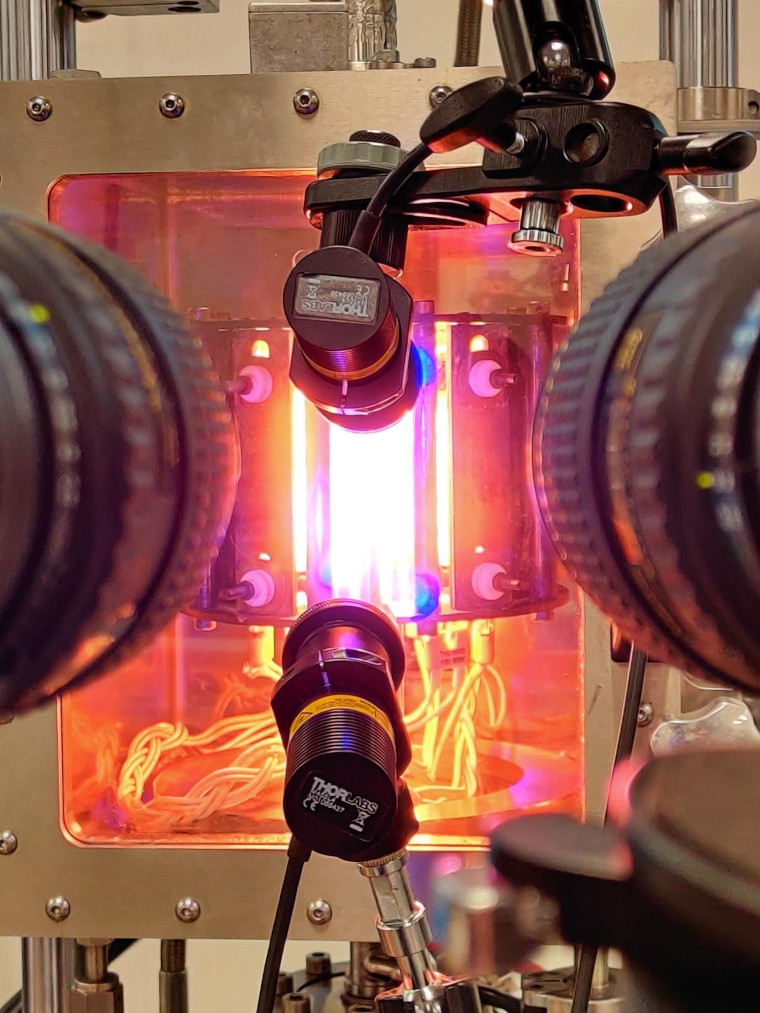
UHT-MaT will be a unique UK facility for the mechanical testing of materials at temperatures exceeding 2,000°C. This is a major step forward in advanced materials research.
Principal Investigator Dr Allan Harte leads the facility. Commissioning is due in 2028 and will feature state-of-the-art environmental conditions and diagnostics.
UHT-MaT is part of the Henry Royce Institute. It will operate under a shared access model, ensuring broad availability to the UK research community. Training, collaborative research, and data-sharing initiatives will further amplify its national impact.
Capabilities
UHT-MaT will allow researchers to understand, optimise and innovate in materials and component technology development for operation at ultra-high temperatures. The facility will support the testing of plasma-facing components in fusion machines, and also materials used for hypersonic flight and thermal-nuclear propulsion in space exploration. These environments produce intense thermal loads and mechanical stresses, which UHT-MaT will provide in a controllable, repeatable way.
UHT-MaT’s core objectives are to provide:
- mechanical material testing at temperatures above 2,000°C – filling a gap in UK capability, which is largely limited to ~1,600°C, and complementing UKAEA’s wider extreme temperature testing capability at material and component scale
- testing in environments relevant to fusion and adjacent industries – including vacuum and gasses
- high quality diagnostics and data capture – supporting a data-centric approach to testing which will validate simulations, characterise uncertainty, and minimise the overall volume of physical testing needed
- a national user facility to maximise economic and scientific impact – supporting the growth of a community for knowledge sharing, and building skills through training
Project information
Design is underway with commissioning expected for 2028. After this will be calls for access.
An Engineering and Physical Sciences Research Council Strategic Infrastructure grant (EP/U537007/1) funds UHT-MaT.