
Overview
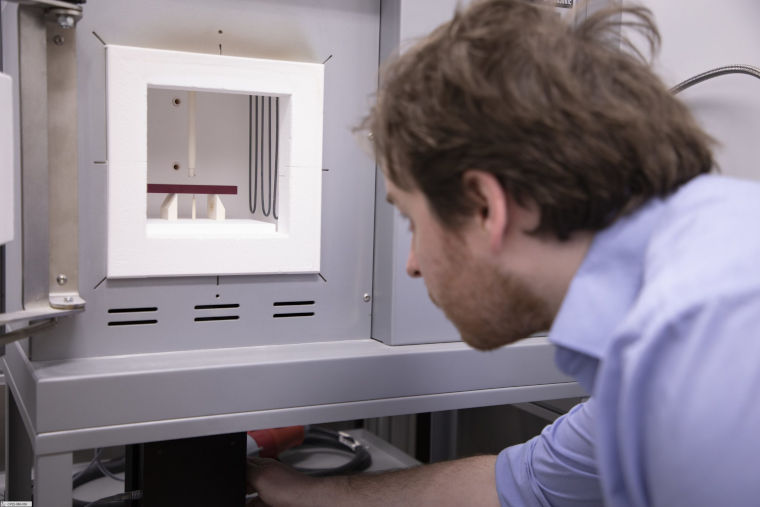
Impulse Excitation Technique, IET, is a non-destructive material characterization technique. It can determine the elastic properties, such as Youngs Modulus or shear Modulus. The furnace allows testing at temperature up to 1500C.
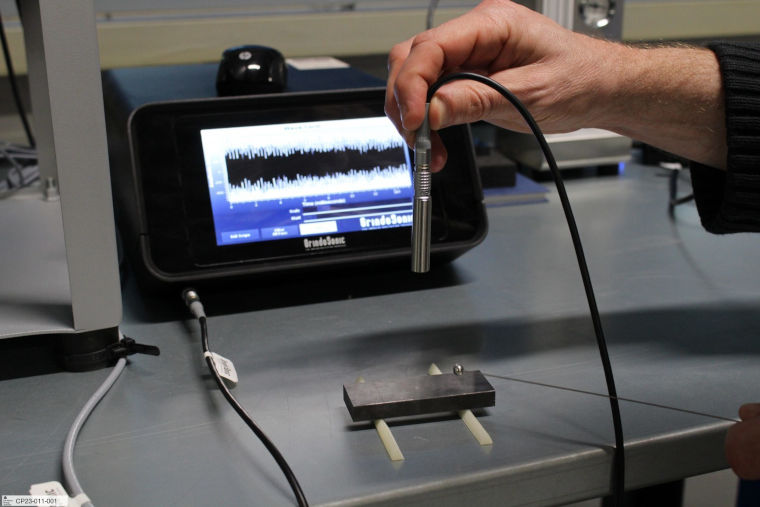
Samples can be of any regular prism geometry. Suspended or held at a specific point in relation to length, the sample can be excited mechanically by lightly striking it with a ‘hammer’. This induces a vibration into the sample, known as the natural frequency. A contact sensor or a microphone picks up the frequency of this vibration. From this, and the materials dimensions, the various modes of vibration can be analysed.
Applications
- testing of metals, ceramics, and composites
- elastic and shear modulus determination
- Poisson’s Ratio
- damping / internal friction characterisation that may arise from changes in internal microstructure and defects.
Technical specifications
- frequency range 20 Hz – 100 kHz
- reference accuracy better than 0.005%
- resolution up to 1/1.000.000
- furnace maximum temperature 1,500 °C
Materials Research Facility
Available for users working in fusion, fission and other research programmes. We have scientific and operational teams to support experiments and sample preparation.