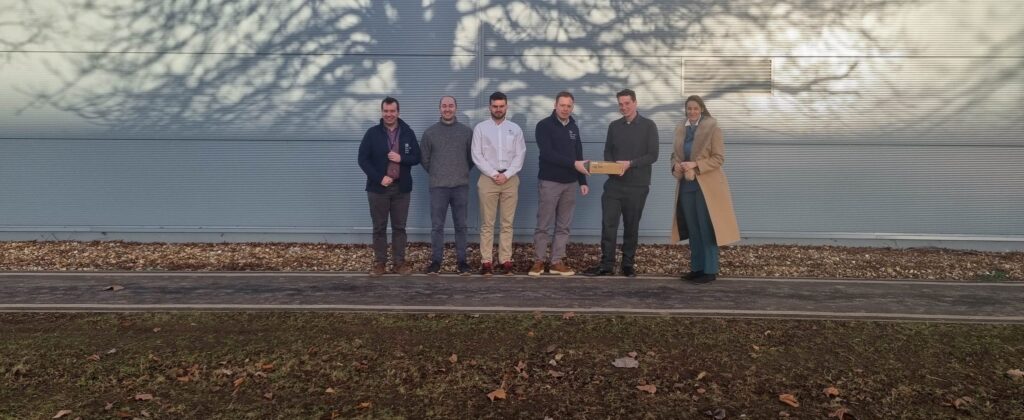
Japanese fusion company, Kyoto Fusioneering (KF) and UKAEA have signed a collaboration agreement to develop fusion energy related technologies.
The collaboration reaffirms the strategic partnership between the United Kingdom and Japan. It is based on a mutual commitment to deliver sustainable, commercial fusion energy for generations to come.
The first project will involve the development of a ‘fusion-grade’ silicon carbide composite system (SiC/SiC), suitable for use as a structural material inside a fusion machine and to understand its stability under simulated fusion conditions.
The use of SiC/SiC composites within the breeder blanket of a fusion machine will increase the efficiency and commercial viability of fusion power stations. This will be by providing a material that operates at high-temperatures and is resistant to neutron damage. The Self-Cooled Yuryo Lithium Lead Advanced (SCYLLA ©) blanket developed by KF is compatible with the lithium-lead based coolant and fuel breeding fluids. Novel materials enable compatibility with the corrosive lithium lead.
KF is expert in the design, experimentation and manufacturing of silicon carbide materials. The company has deep knowledge of making the raw materials for SiC/SiC. It also manufactures silicon carbide composite components, both in-house and in industrial processes. Examination of irradiated composites needs a suitable active testing facility and KF have looked to UKAEA’s Materials Research Facility (MRF) for support.
Scientists and engineers at the MRF have experience in material irradiation and the handling of activated materials. UKAEA is developing new Post Irradiation Examination (PIE) methods. This is to understand the changes in microstructual properties of the SiC/SiC samples caused by radiation damage. As a fibre-reinforced composite, some novel methods need adopting to extract useful material properties.
Under the new agreement, Kyoto Fusioneering will develop critical plant components for other fusion companies around the world.
Kyoto Fusioneering’s CEO, Taka Nagao, said:
The several contracts we have with UKAEA have demonstrated the win-win relationship that can create new value for the society and fusion research and fusion industry. Kyoto Fusioneering will continue to build on our successful technology collaboration to help achieve industrialization of fusion energy. The development of a ‘fusion-grade’ silicon carbide composite system is not only a huge advancement to the realisation of commercial fusion, but also yet another advantage of the blanket system, which is so important in our collective battle against climate change.
UKAEA’s CEO, Professor Sir Ian Chapman, commented:
This collaboration agreement builds on our existing relationship. Putting fusion electricity on the grid requires finding and integrating solutions to several major challenges and we will be working with Kyoto Fusioneering on finding solutions to some of those challenges. The ground-breaking research and innovation being done in the UK, and with our partners across the globe, aims to make fusion a reality which could be transformative for energy security and climate change.
UKAEA has awarded KF several contracts. They provide expertise and services, most notably as a member of the Spherical Tokamak for Energy Production (STEP) Interim Engineering Delivery Partner consortium. KF is also a Tier 1 supplier in 2021 under the UKAEA Tritium Engineering Framework for the STEP fuel cycle.
KF is driven by a collective effort to commercialise fusion to deliver a new sustainable energy for the future for humankind.
UKAEA is the UK’s national research organisation responsible for the delivery of fusion energy. This could be transformative for energy security and important in the fight against climate change.