A fusion energy machine vital for the delivery of the UK’s first prototype power plant is conducting a crucial second round of experiments. It will help make ‘star power’ part of the world’s future energy mix.
- Mega Amp Spherical Tokamak Upgrade (MAST Upgrade) machine tackles further technical challenges for long-term viability of future fusion power plants
- Experiments test the integration of a high-performance core plasma with strong dissipation in the Super-X divertor configuration
- Exchequer Secretary James Cartlidge hails power of future green technologies in strengthening UK’s energy security
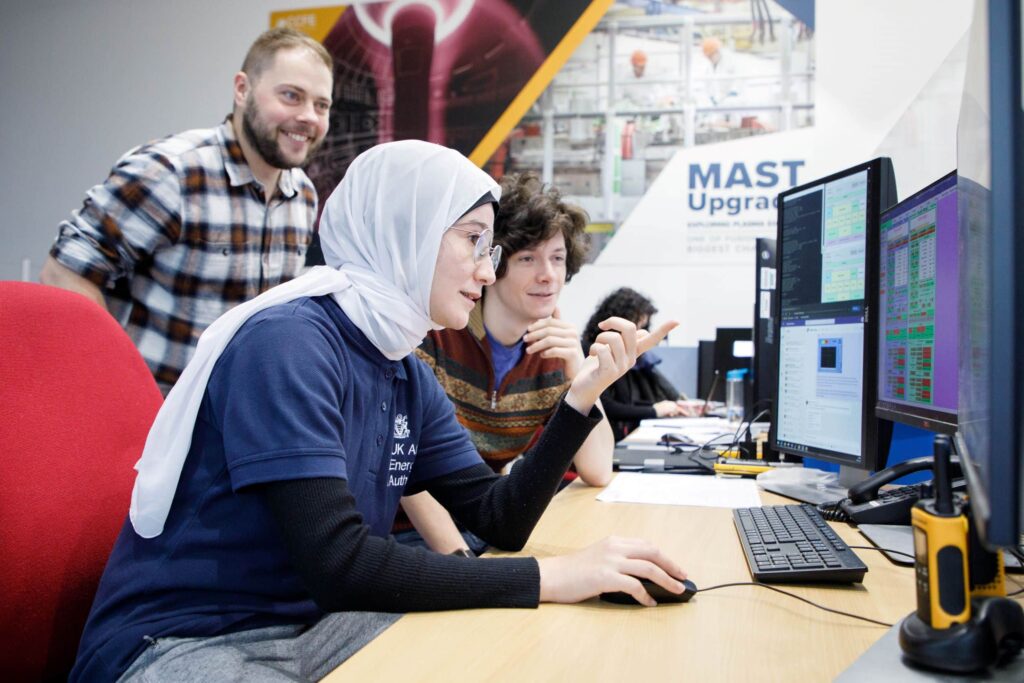
UKAEA’s MAST Upgrade will run the experiments until the end of January 2023.
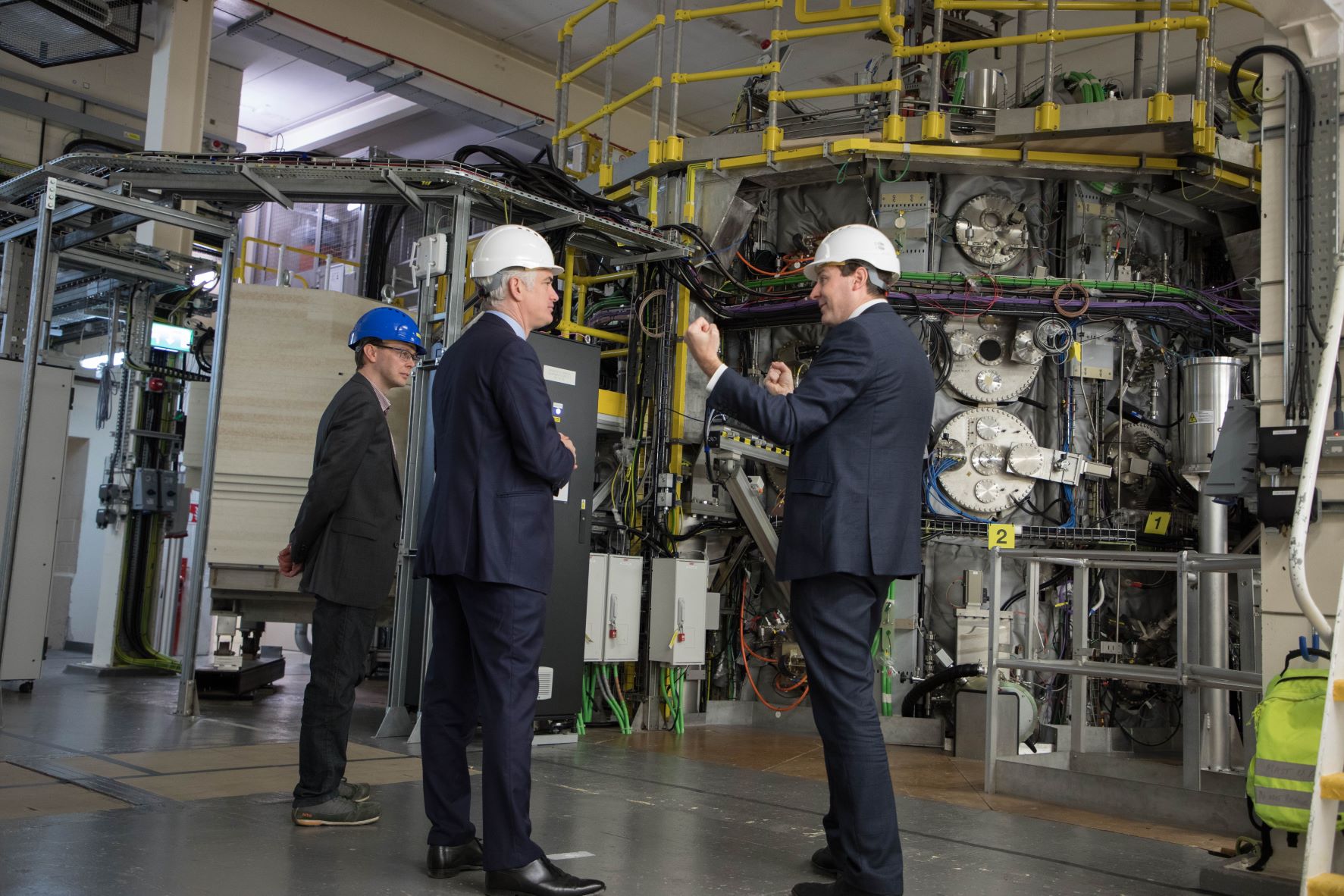
Following a visit to UKAEA in Culham, Oxfordshire, earlier this week, Exchequer Secretary to the Treasury, James Cartlidge, said:
It was an inspiring tour of UKAEA where I was able to see how the UK is developing fusion energy, the process that powers the sun, to generate carbon-free electricity.
The visit reinforced our commitment to increasing public R&D spending to record levels of £20 billion a year by 2024/25, which includes funding for green tech of the future, like this.
MAST-U resembles the shape of a cored apple, in contrast to the ring-shaped record-breaking JET (Joint European Torus). This configuration is currently the preferred design for the UK’s prototype fusion plant, STEP (Spherical Tokamak for Energy Production).
Fusion energy offers the potential of an abundant, inherently safe low-carbon electricity supply. It involves fusing hydrogen particles in a hot gas known as a ‘plasma’ to unlock large amounts of energy.
Operating fusion technologies requires a careful balancing act of controlling extreme heat, gas and magnetic fields, amongst other complex systems.
Last year, MAST Upgrade’s novel exhaust system, Super-X, successfully demonstrated its effectiveness. It did this by generating a tenfold reduction in the energy fluxes of the plasma channelled out of the machine. This would allow components in future commercial tokamaks to last longer.
The current run of experiments will investigate how the compact tokamak can combine the benefits from this exhaust using different parameters – higher temperature and pressure, and increased performance caused by operating within a stronger magnetic field – as well as improving shape control of the plasma within the machine.
The core plasma shape will be controlled in real-time and in collaboration with General Atomics.
MAST Upgrade’s experiments will also support the study of detachment physics – the reduction of pollution of the core plasma by impurities coming from the wall. This experiment is for EUROfusion, a consortium of national research institutions located in the EU, Switzerland, UK and Ukraine.
The phased work will investigate how plasma confinement can be optimised for future power plant conditions.
Commenting on the new experiments, Professor Fulvio Militello, Director of Tokamak Science, UKAEA, said:
To create fusion in a power plant, a plasma must be sustained inside a tokamak whilst optimising three conditions: temperature, density and confinement time.
The new round of experiments conducted by MAST Upgrade will test the integration of a high-performance core plasma with strong dissipation in the Super-X divertor configuration.
Results from the experiments will contribute to the success of the government-funded STEP programme. STEP is aiming to demonstrate the feasibility of putting fusion energy on the grid, targeting operations by 2040.
MAST Upgrade achieved its first plasma in 2020 after a rebuild. This was to enable higher performance, including longer times plasmas are held in confinement, increased heating power and a stronger magnetic field, alongside its innovative plasma exhaust system.
“UKAEA is exploring pathways to compact and affordable fusion machines and believes the apple-core design holds real promise” continued Professor Militello.
As well as STEP, MAST Upgrade will also aid preparations for ITER – the world’s largest science megaproject. ITER is under construction in the South of France and intends to demonstrate the viability of fusion on an industrial scale.