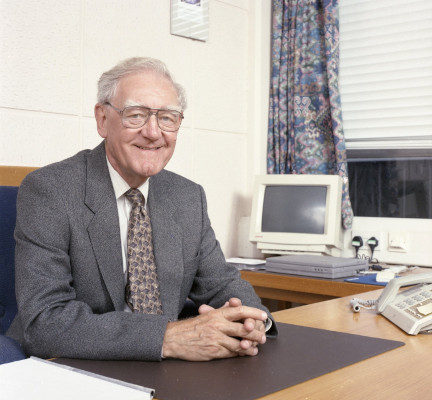
It is with great sadness that we share the news of the passing of Bryan Taylor on 14 May, 2026. He was one of the most influential figures in British and international plasma physics, and a scientist whose career was deeply interwoven with Culham and the UK fusion programme.
Bryan’s early work at the Atomic Weapons Research Establishment made important physics contributions to the development of Britain’s nuclear deterrent. He was then attracted to the emerging potential of fusion energy. Joining UKAEA’s Culham Laboratory in the early 1960s, he later served as Chief Physicist and Head of Theory.
Bryan built an internationally-renowned theory team at Culham. He made numerous foundational contributions to plasma theory and fusion science over several decades. One of the best known is the development of the theory of plasma relaxation to a minimum-energy state under magnetic helicity conservation. This is the so-called Taylor state which has had a lasting impact across magnetic confinement fusion and wider astrophysical and solar plasma research.
His work also shaped our understanding of plasma stability, turbulence and chaos in magnetically confined fusion plasmas. These include the prediction of the bootstrap current some 20 years before it was observed experimentally. This is now fundamental to the design of fusion power plants like STEP.
With Jack Connor and Jim Hastie – a famous trio in the theory of fusion plasmas – he predicted the ballooning mode instability. This is now associated with tokamak plasma eruptions called edge-localised modes (or ELMs). The theory included the construction of a new mathematical concept called the ballooning transform. This now underpins much of what we understand about turbulence and transport in toroidal fusion plasmas (so-called local gyro-kinetics). These are just a few examples of the enormous impact Bryan has had on the field of fusion energy.
These theoretical foundations continue to underpin fusion research worldwide. At the same time as establishing these, he mentored generations of plasma physicists. Many will have benefited from his enormous talent and the depth of his knowledge. His influence extended internationally. He spent significant periods at the Institute for Advanced Study at Princeton and the University of Texas at Austin. Bryan remained active and engaged well into his later years. He connected to our Physics and Technology meetings, and shared his insights until very recently.
In recognition of his achievements, Bryan was elected a Fellow of the Royal Society. He received numerous major honours. These included the Maxwell Medal, the Max Born Medal, the James Clerk Maxwell Prize for Plasma Physics, and the Hannes Alfvén Prize. Beyond these distinctions, colleagues will remember him for intellectual clarity, rigour, and a generosity of spirit that shaped both people and ideas.
Bryan will be sadly missed by his family, friends, and the many colleagues and friends in Culham and around the world who were influenced by him and his work. UKAEA’s fusion programme today is built on the work of pioneers like Bryan. His scientific legacy will continue to shape fusion research for decades to come.