
A new, multi-wavelength imaging (MWI) camera diagnostic fitted on MAST Upgrade, will offer scientists a picture of the impact that the machine’s Super X divertor design has on the hot, charged plasma.
The Super X divertor or ‘exhaust’ system on MAST Upgrade has already shown at least a tenfold reduction in the heat leaving the main plasma chamber. Now, there is a new filtered imaging system. This provides 11 views of the divertor simultaneously. Scientists will be able to get more insight into how this divertor works than ever before.
Scientists routinely measure light emitted by the plasma in the divertor region. This is in order to work out the plasma conditions and plasma performance. The MWI has 11 cameras filtered to target a different wavelength band of this emitted light — for example, a different colour. Due to a physics process called ‘spectral line emission’, these different wavelength bands correspond to light emitted by different elements that are present in the plasma. This means that some of the MWI cameras can capture videos of the main hydrogen fuel. Other cameras can capture videos of impurity elements like carbon and helium at the same time. The original MAST experiment only had a single filtered camera viewing its divertor. Now, the MWI captures a lot more useful data each time the experiment runs.
Durham University, the University of York and scientists at Culham developed the MWI system over the last three years. It builds on similar work at the Dutch Institute For Fundamental Energy Research (DIFFER) and the TCV tokamak in Switzerland. DIFFER collaborators are now helping scientists at Culham interpret the MWI data taken on MAST Upgrade.
Joe Allcock, Spherical Tokamak Imaging Researcher at UKAEA, said:
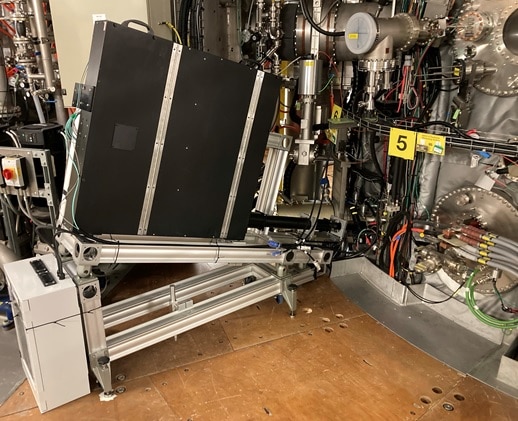
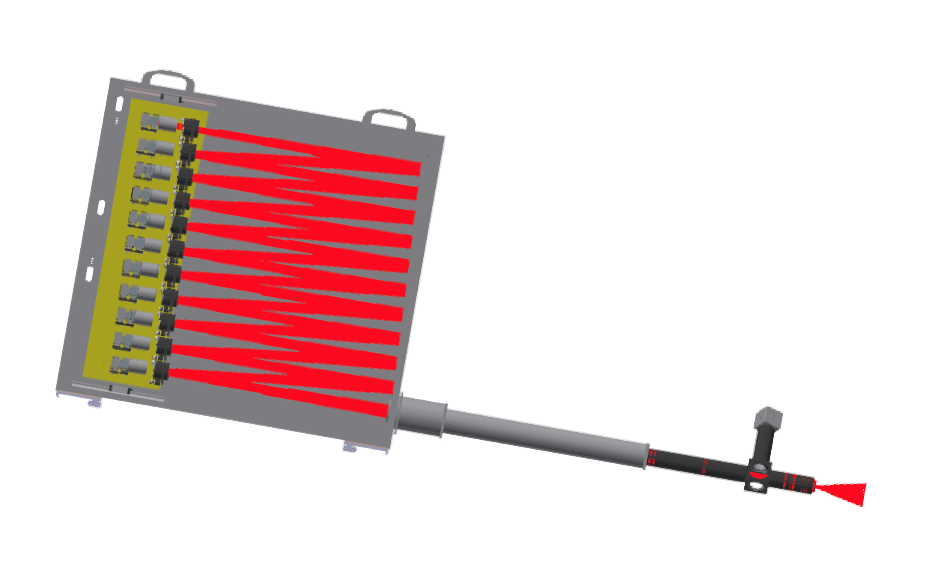
The MWI camera system is essentially 11 cameras in a row inside a large black box with a tube at one end. This tube looks down through a port window and into the divertor region below the main plasma chamber.
The path of light through the system is in red in the diagram below (Xiande Feng, Durham University)
The photograph below then shows what the MWI looks like after installation on MAST Upgrade.
Joe added that one of the key performance indicators of a divertor was the amount of power deposited by the plasma onto the walls.
We developed this Super X design because our physics simulations predict we should see a drop in the power that’s reaching the divertor target. By comparing these simulations to data from the MWI and other diagnostics, we can gauge how accurate our physics understanding is, and how reliable our predictions will be when we design a future fusion reactor.
Whereas other diagnostic techniques – like the Thomson scattering laser system – offer an excellent picture at a few single points in the plasma, the MWI has a wide view, helping us build up a comprehensive idea of what is happening, and where, across the divertor. This is essential for improving our understanding of the physics behind the Super X.