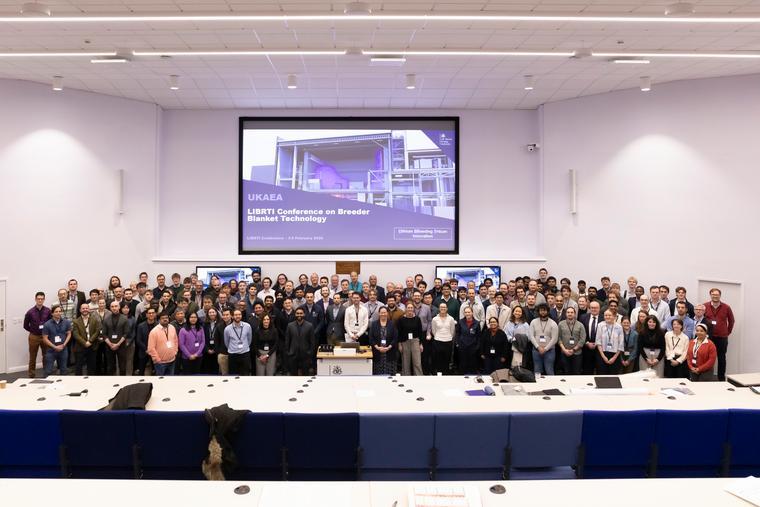
In February, UKAEA’s Lithium Breeding Tritium Innovation (LIBRTI) programme hosted its first international conference at Culham Campus. With over 185 attendees, the three-day event marked a significant moment in the future of fusion fuel-cycle innovation.
Adam Baker, Head of Fusion Policy at the Department for Energy Security and Net Zero (DESNZ), opened the conference. It brought together the global breeder blanket community to explore the latest advancements, challenges, and collaborative opportunities shaping the field. Contributions to the conference included speakers from UKAEA’s LIBRTI team, UKIFS, industry, academia and leading international partners.
The LIBRTI programme works on advancing fusion breeding technologies through a world-leading demonstrator facility with predictive multi-physics capability. The facility will be a user-testbed for engineering scale tritium breeding experiments enabling fusion technology testing and demonstration alongside a multi-physics platform to inform technology design for our users and partners.
The conference held 13 sessions covering advanced breeder and structural materials, historical tritium breeding strategy reviews, small breeder experiments and simulations. Discussions continued beyond the formal agenda, with attendees commenting on how refreshing it was to see global momentum behind breeder blanket development.
Amanda Quadling, Executive Director of Materials, Blankets and Research, said:
It has been a pleasure to host the LIBRTI Breeder Technology Conference and bring together colleagues working across breeder system development nationally and internationally. The discussions and technical updates shared this week highlight the progress being made and the importance of continued collaboration in this area. I appreciate the contributions from all participants and look forward to seeing how this work moves forward in the months ahead.
An attendee of the conference commented:
My biggest takeaway has been the broad range of approaches and people that have come from different parts of the world for the conference. In addition, I’ve gained insight into current projects and experiments being conducted – it’s fascinating and I’ve learnt a lot.
Another attendee added:
I was very impressed by the tritium-based modelling. Tritium is central to a lot of my research and the work presented has been extremely unique and novel.