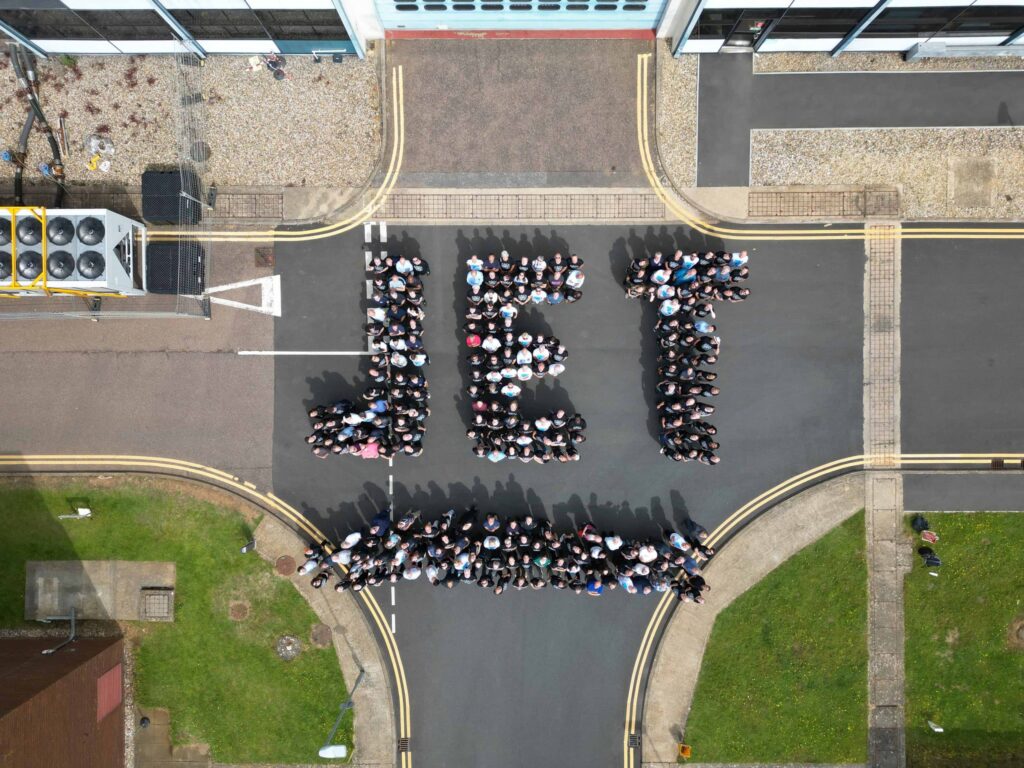
One of the world’s largest and most advanced fusion energy tokamaks turns 40 on Sunday 25 June.
It was originally designed to run experiments for eight years. Scientists and engineers around the world are now celebrating the Joint European Torus (JET) to mark four decades of fusion research and development.
JET uses magnetic fields to confine its plasma, a superheated gas of hydrogen isotopes, in the machine. Under intense heat – 150 million degrees Celsius, ten times hotter than the core of the sun – and pressure, hydrogen fuses into helium, releasing energy as neutrons.
JET produced its first plasma on 25 June 1983. It has achieved many firsts, helping to push the understanding of fusion science forward with significant advances. This is in the quest to develop fusion energy as a safe, low-carbon and sustainable part of the world’s future energy supply. Her Majesty Queen Elizabeth II officially opened JET at UKAEA’s Culham Campus in Oxfordshire, England. It is currently the only tokamak that operates using deuterium and tritium.
Notable achievements by JET include:
- 1983: First plasma
- 1984: Official opening by Her Majesty Queen Elizabeth II
- 1991: First deuterium-tritium plasma created and world record at 1.8MW
- 1997: First deuterium-tritium experiments and world record for producing 16.1 MW and 21.7 megajoules
- 2011: ITER-like metal wall installed
- 2021: Second deuterium-tritium experiments and world record for sustained fusion energy at high power producing 59 megajoules over 5 seconds, demonstrating fusion power plant potential
- To date it has produced over 103,000 ‘pulses’ – each pulse is a plasma created and held in the JET machine to do a specific experiment. Each pulse typically lasts for 40 seconds.
UKAEA has operated JET on behalf of EUROfusion – a consortium of national fusion research institutes located in Europe until 2023. Then it fully handed over to the UK.
JET has created many partnerships in fusion and beyond. This includes the establishment of a European school in 2012. It continues to offer a multilingual curriculum as Europa School UK.
JET’s research will continue to benefit ITER and many other fusion programmes worldwide. ITER is the international tokamak experiment under construction in southern France. It aims to show that fusion can work at the scale of a power plant.
Professor Sir Ian Chapman, CEO, UKAEA, said:
JET is the most important fusion experiment ever and it has left an indelible mark on history. Without JET, the fusion field would not be where it is today.
The fact that we got the record power in 1997 gave us confidence to go ahead and build ITER and the 2021 results give us confidence that we are on track for taking the next step towards fusion power plants. These things just would not be happening without JET.
JET is also both a literal and a metaphorical big magnet that draws people and partners to Culham. As well as being at the forefront of pioneering science, is also at the forefront of developing partnership in industry.
Tony Donné, EUROfusion Programme Manager, said:
JET stands as an extraordinary testament to European cooperation and international collaboration. For four decades, this collaborative spirit has thrived within JET, serving as an exemplary model for fostering global unity.
As a cutting-edge fusion energy research facility, JET’s impact is unmatched. Its groundbreaking experiments and unparalleled performance records have surpassed the achievements of every other fusion machine, solidifying its position as a pioneer in the field.
Fusion energy could be transformational for energy security and climate change in the latter part of this century.
UKAEA will continue operating JET to support ITER for its final experiments this year. Following that, it will be the world’s first fusion energy machine to move into repurposing and decommissioning.