
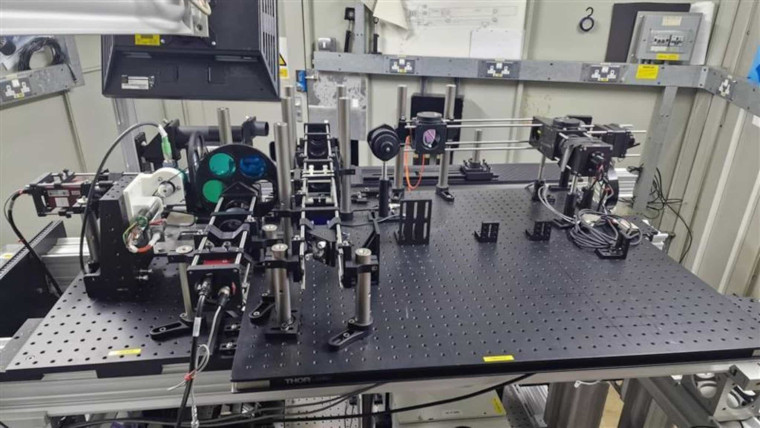
- First of JET’s unique scientific diagnostics despatched to FZJ at Max Planck Institute, Germany
- Further assets to support fusion programmes in four countries, including the UK
- JET Decommissioning and Repurposing also facilitating infrastructure development at Culham for key UKAEA research
JET’s unique scientific equipment enables analysis of experimental results and assessment of the impact for fusion power plant predictions. European laboratories and machines are also repurposing it.
A series of specialist diagnostics captured JET’s scientific advances. These provided invaluable and comprehensive data and insight to the multinational teams of researchers who worked at Culham Campus during JET’s four decades of plasma operations.
The JET Decommissioning and Repurposing (JDR) team has successfully disconnected, packaged and despatched a diagnostic, designated KT3, to Germany. There, Forschungszentrum Jülich (FZJ), operator of the Wendelstein 7-X stellarator will use it.
KT3 provided profile data into the critical distribution and movement of particles at the divertor. the part of the tokamak where most of the energy and particle interactions occur with the plasma-facing wall.
Over the next few months, further diagnostic equipment will be prepared for dispatch to CNR in Italy, VR-Sweden, and to MAST Upgrade at Culham Campus.
Zac Scott, Director JET Decommissioning and Repurposing, UKAEA:
The JDR Repurposing team has established robust and methodical processes for repurposing some of JET’s assets. This will stand us in good stead as the programme evolves over time, and the lessons learned will add value to future planning. I really like the idea that JET systems can live on beyond the end of JET’s operational lifetime.
Josh Glass, Repurposing Programme Manager, JET Decommissioning and Repurposing, UKAEA:
JET is probably one of the first programmes of its kind where, at the end of its life, just as many organisations and people approached us to repurpose equipment as we have reached out to. We’ve had to work out the best route forward for all of our stakeholders and that is done with a huge amount of collaboration. We’re funded by the government and we need to deliver on taxpayers’ money.
Joelle Mailloux, Head of JET Science, UKAEA:
It is important for us that JET’s components go to other European laboratories because JET was a European project. We see this as a continuation of JET, in a sense. The fact that these diagnostics are going to be repurposed on machines elsewhere in Europe just emphasises that fusion is international research done collaboratively.