Most approaches to creating commercial fusion favour the use two hydrogen isotopes – deuterium and tritium – preferred in tokamaks like JET and in future fusion power plants.
Deuterium is plentiful and can be extracted from seawater. Tritium, a radioactive isotope of hydrogen, is scarce and has a half-life of about 12 years. When they fuse together, they produce helium and vast amounts of energy.
Anna Widdowson, UKAEA’s Erosion and Deposition Group Leader, said:
When you run the deuterium-tritium fusion process, tritium gets absorbed by the tokamak’s inner wall during the energy reaction
It diffuses from the surface of components into the material and becomes trapped. The amount of trapped tritium needs to be accounted for as part of the overall management of tritium in the fusion fuel cycle. Therefore, a method for releasing and measuring tritium in the tokamak wall is needed.
EUROFusion scientists and engineers at world-leading UKAEA JET research facility successfully used a laser based diagnostic method to do this. Laser Induced Desorption Quadruple Mass Spectrometry (LID-QMS) is the act of laser pulsing materials and surfaces to release and measure tritium. This is the first time in a deuterium-tritium fusion environment.
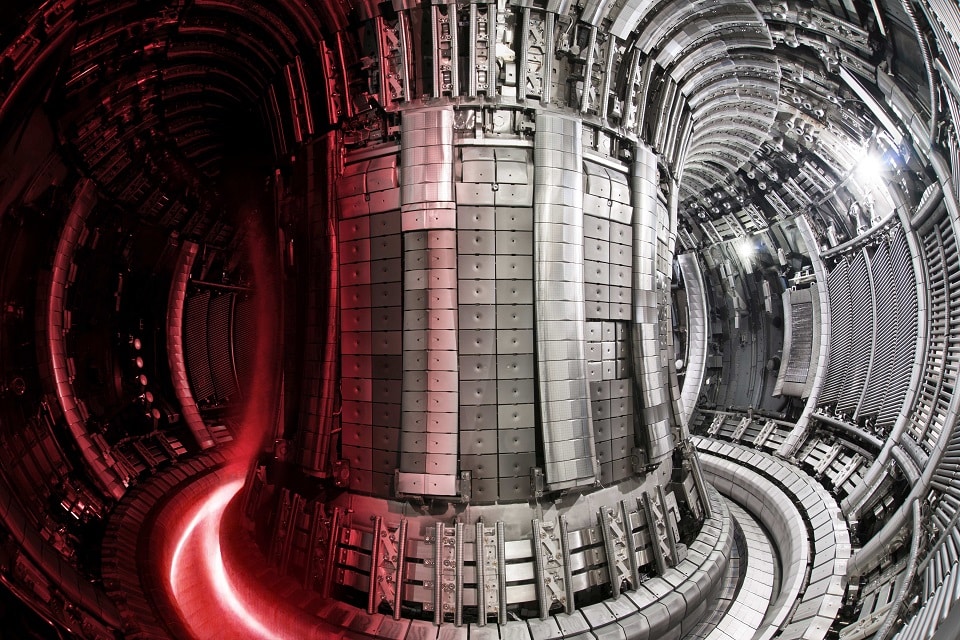
Fast heating the tiles in JET with a high-powered laser causes the rapid expansion and evaporation of gases retained in deposits on the tile surface. The released gases include tritium. Mass spectrometers then identify and measure them.
The control of the LID-QMS laser targeting is extremely challenging. The laser beam path is 35-metres long and is capable of delivering 100 laser spots spaced 3 mm apart along a snake-like path in just two seconds.
The same laser-based techniques apply to future fusion machines with different in-vessel wall materials,. This provides the potential for in-vessel tritium monitoring which in turn brings potential for efficiency in operation.
Dr Widdowson said :
It is a huge achievement to demonstrate a reliable way to measure tritium retained within a fusion device without the costly interruption to operations to take materials for sampling.
LID-QMS is a ground-breaking piece of work, which is a true collaborative effort between colleagues at UKAEA and Forschungszentrum Jülich, Germany. This will help inform the tritium inventory management and operation of future deuterium-tritium fusion machines.
The LID-QMS diagnostic experiment is one of the last ever for JET. Its scientific operations conclude at the end of this year.
JET will move on to the next phase of its life cycle in early 2024 for repurposing and decommissioning. This will last until c.2040.
JET has played a critical role in accelerating the development of fusion energy. Fusion energy promises to be a safe, low carbon and sustainable part of the world’s future energy supply.
The UK’s next deuterium-tritium fusion facility is the prototype fusion power plant, STEP. It is set to be built by 2040 in Nottinghamshire.