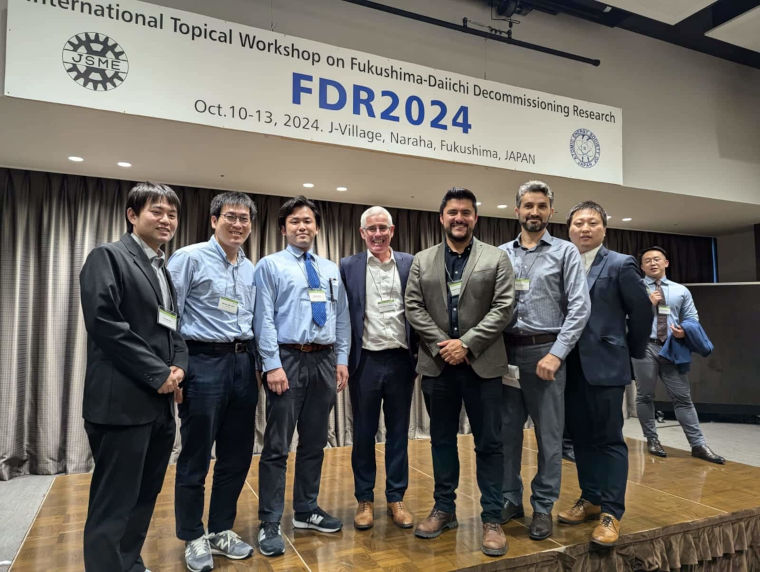
Some of the Tokyo Electric Power Company (TEPCO) secondees of the LongOps project joined robotics researchers at UKAEA at the International Topical Workshop on Fukushima-Daiichi Decommissioning Research 2024 (FDR2024). They shared the outcomes of the project.
The Nuclear Decommissioning Authority (NDA), the UK Research and Innovation (UKRI) and TEPCO funded the LongOps collaborative research project. The aim was to develop digital tools to enable faster, safer and more cost-effective decommissioning. From Japan, the focus was the decommissioning of the Fukushima Daiichi reactors. In the UK, it was Windscale Pile 1 at NDA’s Sellafield site and UKAEA’s Joint European Torus (JET) fusion machine in Culham Campus.
Novel research results covered:
- special software design
- teleoperated haptic systems
- machine learning
- massive data-asset management
- long flexible robots for faster, safer and more cost-effective decommissioning
FDR promotes a global exchange of information on technologies, operations, management and safety. It does this for the research and development activities on decommissioning and dismantling of the Fukushima-Daiichi nuclear power plant. FDR2024 was held in Fukushima, Japan from 10 to 13 October 2024. It welcomed over 200 researchers from around the world. This follows the successful meetings held in 2019 and 2022.
Rob Buckingham, Executive Director, UKAEA commented:
Through our presentations on the achievements of the LongOps project, we have demonstrated a leading collaborative research approach between government, industry and academic sectors. This approach will increasingly be important to apply research into application to bring fusion energy to reality and for the decommissioning of JET and facilities in Sellafield and Fukushima. The potential of exploitation of remote maintenance technologies in other industrial facilities is also significant.
Rob Buckingham gave a plenary speech entitled ‘The benefits of a digital twin in support of complex long-term remote operations.’
The following UKAEA researchers presented on robotic and digital technologies for hazardous environments which were developed under the LongOps project:
- Kaiqiang Zhang, Principal Robotics Research Engineer, RACE (Remote Applications in Challenging Environments) – ‘Efficient and Safe Fuel Debris Retrieval Utilising Long-Reach Manipulators Through Advanced Control Techniques and Motion Planning’
- Harun Tugal, Senior Robotics Research Engineer, RACE – ‘Advancing Evaluation Methodologies for Bilateral Telerobotic Systems in Hazardous Environments’
- Ipek Caliskanelli, Principal Robotics Research Engineer, RACE – ‘Software development principles for nuclear applications, requirements capture and verification process’ (presented by Kaiqiang Zhang on behalf of the author)
- Salvador Pacheco-Gutiérrez, Head of RAICo Technology – ‘Enhancing Nuclear Decommissioning Through Integrated Sensor Data, Advanced Visualisation and Asset Management: LongOps, What Is Next?’
- Muhammad Rashid Maqbool, Senior Control Systems Engineer, RACE – ‘Development of datasets and machine learning models to enhance perception for Fukushima Daiichi Decommissioning’ (presented by Salvador Pacheco-Gutierrez on behalf of the author)
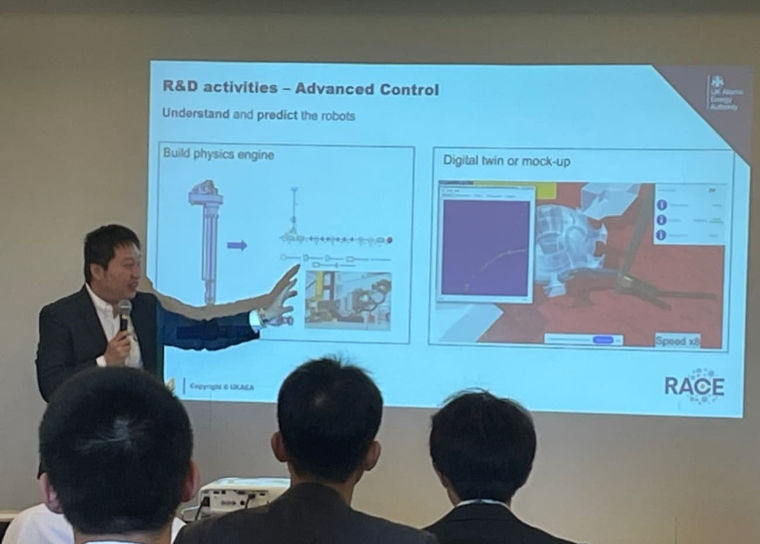
The UKAEA researchers discussed the applications of multidisciplinary technology to nuclear decommissioning practice with researchers and engineers from reputed universities. These included The University of Tokyo and Tohoku University and Fukushima University. Also present were research institutes Japan Atomic Energy Authority (JAEA), Japan’s National Institutes for Quantum Science and Technology (QST) and Korea Atomic Energy Research Institute. Leading industrial partners included Hitachi-GE Nuclear Energy, TEPCO and Tousou Mirai Technology.
The academia and industry cohorts expressed the importance of enhancing international collaborations, especially between UK and Japan. They also emphasised focusing on research oriented by engineering practice.
The conference chair was Professor Koji Okamoto, the Head of Collaborative Laboratories for Advanced Decommissioning Science (CLADS) at JAEA. He indicated the need for maintaining a strong, close research collaboration in the field of decommissioning between the UK and Japan in response to common critical challenges in the sector.
At the banquet closing the Day 1 programme, Rob Buckingham called for the formation of ‘Young Decommissioners’. This is an international initiative to form a group of talented and diverse people to lead decommissioning work in the future.
Rob Buckingham said:
Decommissioning is a normal part of a nuclear facility’s lifetime, both in fission and fusion, and a key step in the delivery of a reliable, safe and affordable low-carbon source of energy. It’s an exciting and meaningful area which requires innovative ideas and international collaboration to shape the future.
If you are interested in collaborating with RACE, contact the team.