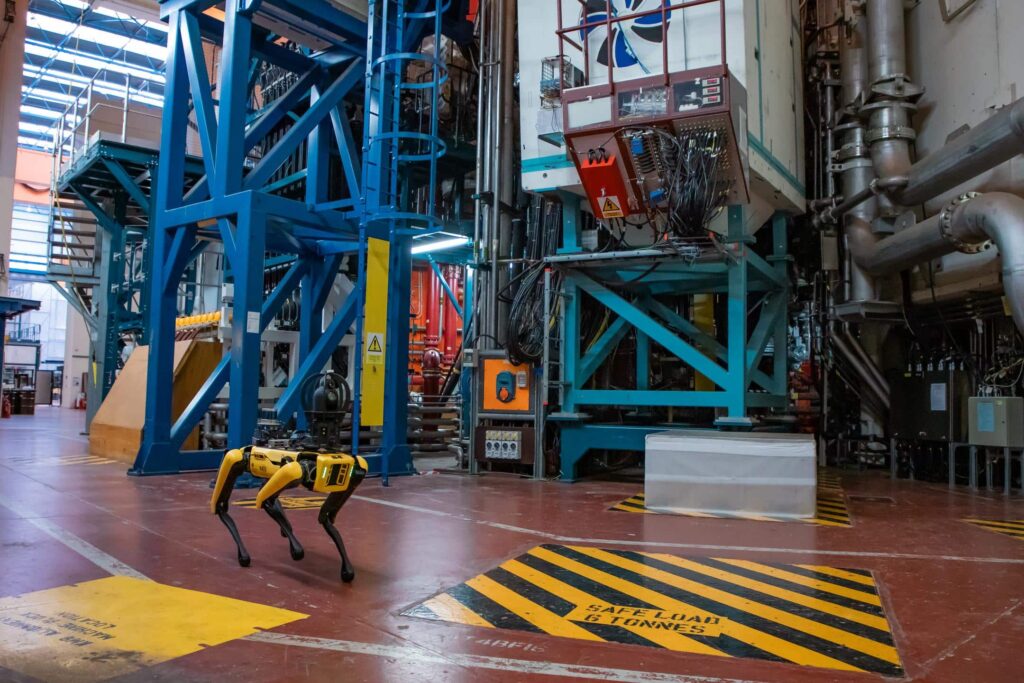
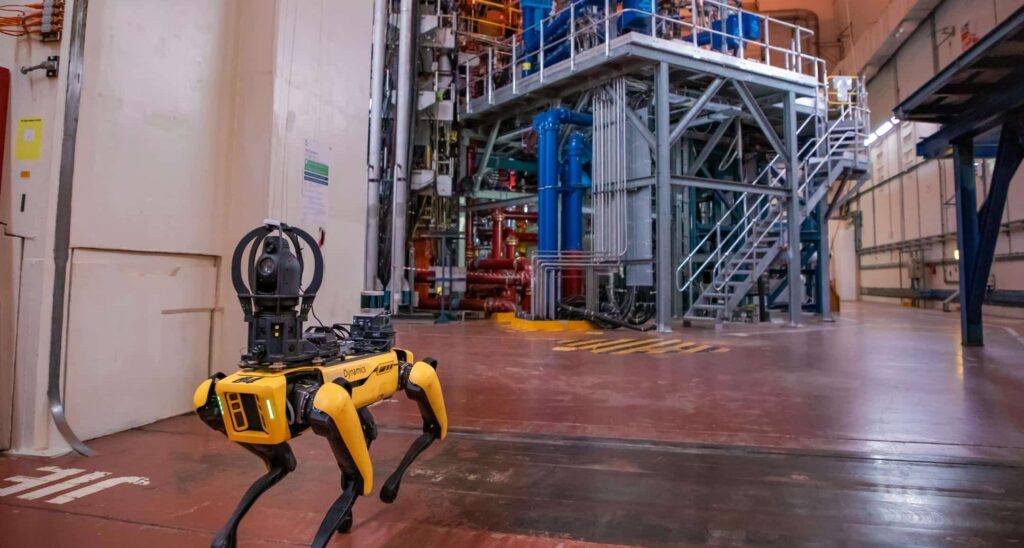
UKAEA and the Oxford Robotics Institute (ORI), University of Oxford, have achieved a first-ever autonomous robot deployment in a fusion facility.
The 35-day trial took place in UKAEA’s Joint European Torus (JET) facility. Until its recent scientific operational shutdown, JET was one of the largest and most powerful fusion research machines in the world.
A world-leading robotics alliance has successfully demonstrated that an autonomous robot can carry out part of a fusion facility’s maintenance. This is a step towards the commercial viability of fusion energy. It makes such work safer for humans and more cost efficient for its operator.
Fusion power plants will need regular maintenance. Traditionally, robotic inspections required humans to make decisions and to operate.
Dr Robert Skilton, Head of Research, at UKAEA’s Remote Applications in Challenging Environments division, said:
The project aimed to validate the reliability of autonomous robotic technology and instil trust and confidence in their use for safe and efficient inspections in fusion facilities over extended periods,
Such advancements pave the way for autonomous maintenance and decommissioning in future fusion facilities. In these, human access may be limited and challenging due to radiation, vacuum-level pressure and extreme temperatures.
JET provided the ideal opportunity to test ORI’s autonomy platform ‘AutoInspect’ controlling a Boston Dynamics Spot quadruped robot. This was in an environment still hazardous after two high-powered deuterium-tritium experiments in the space of three years.
Dr Skilton continued:
This deployment demonstrates that autonomous robots can enhance safety and cut costs. These ‘next generation’ solutions are becoming ready to be used in other industrial facilities such as nuclear decommissioning, environmental clean-up, and disaster relief,
The inspection tasks within JET involved mapping the entire facility, taking sensor readings of its environment, and avoiding obstacles and personnel involved in the decommissioning process.
To address these challenges, UKAEA’s inspection payload integrated with ORI’s localisation and mission autonomy solutions. Professors Hawes’ and Fallon’s teams collaborated on the development of this. The setup combined with Boston Dynamics’ hardware and collision avoidance technology to enhance the robot’s capabilities.
This integrated robotic system collected essential data on JET’s environment and overall status twice a day. It allowed the team to assess the feasibility of replacing human inspections with fully autonomous processes.
Prof. Nick Hawes, Professor of AI & Robotics, University of Oxford, said of ORI’s aims in the project:
Projects like this demonstrate the value of autonomous robots – robots that can do things themselves without direct control of humans. They also ground our science in real use cases, and provide requirements and constraints that drive us to invent new AI and robotics algorithms.
The Engineering and Physical Sciences Research Council supported ORI’s work in this project. This was through the ‘Embodied Intelligence: From Sensing to Collaboration’ programme grant which aims to create autonomous systems that enhance human capability and potential.
The results will assist planning for the next stages of the JET decommissioning and repurposing (JDR) programme.