Overview
In an innovative collaboration, scientists and engineers from the UK Atomic Energy Authority (UKAEA) and the University of Bristol have developed the world’s first carbon-14 diamond battery—a revolutionary energy source capable of powering devices for thousands of years.
This case study highlights the challenges overcome, the innovative solution developed, and the transformative potential of this technology across multiple sectors.
Diamond batteries offer a safe, sustainable way to provide continuous microwatt levels of power. They are an emerging technology that use a manufactured diamond to safely encase small amounts of carbon-14.
Sarah Clark, Tritium Fuel Cycle Director, UKAEA
Key highlights
- collaborative innovation – UKAEA and University of Bristol
- breakthrough technology – carbon-14 diamond battery
- global impact – strengthening fusion research and sustainable energy solutions
Background
UKAEA leads the UK’s efforts in developing sustainable fusion energy—a clean, safe, and low-carbon power source for future generations. Fusion research not only advances energy science but also drives innovation in adjacent technologies.
As part of this mission, UKAEA partnered with the University of Bristol to develop a plasma deposition rig—a specialist device used to grow diamond material. This rig was built at Bristol University but operates at UKAEA’s Culham Campus.
The challenge
The project faced some key hurdles:
- specialist training needs – expertise in plasma deposition and handling materials was essential
- regulatory compliance – carbon-14 is a regulated isotope in the UK, requiring strict safety protocols
To overcome these barriers, the University of Bristol turned to UKAEA for technical expertise, and regulatory guidance.
The solution
UKAEA and University of Bristol scientists and engineers collaborated to design and build a plasma deposition rig capable of growing a diamond under low-pressure conditions. This rig successfully encased a semiconducting carbon-14 isotope within a thin diamond layer.
The resulting battery harnesses the decay of carbon-14—which has a half-life of 5,700 years—to generate continuous, low-level power. Unlike solar panels that convert photons into electricity, this battery captures fast-moving electrons from within the diamond structure to power devices. This makes the battery ideal for working in remote or challenging environments.
Applications and impact
The carbon-14 diamond battery opens up possibilities for long-term, low-maintenance power in extreme or inaccessible environments:
- medical devices – biocompatible batteries for pacemakers, hearing aids, and ocular implants—reducing the need for replacements and improving patient outcomes
- space and deep-sea exploration – powering devices in harsh environments where battery replacement is impractical
- security and tracking – enabling long-life radio frequency tags for spacecraft, payloads, and remote sensors
Our micropower technology can support a whole range of important applications—from space technologies and security devices to medical implants. We’re excited to explore these possibilities with partners in industry and research.
Professor Tom Scott, University of Bristol
Outcomes
The collaboration between UKAEA and the University of Bristol delivered significant achievements:
- breakthrough innovation – successfully developed the world’s first carbon-14 diamond battery—an unprecedented advancement in energy technology
- reducing waste – the carbon-14 diamond battery could transform the battery industry by minimising replacements and, with more research could eventually replace lithium-ion batteries
- applied fusion expertise – demonstrated how fusion-related research can be translated into practical engineering solutions
- knowledge exchange – strengthened partnerships through shared expertise, fostering collaboration across academia and industry
Conclusion
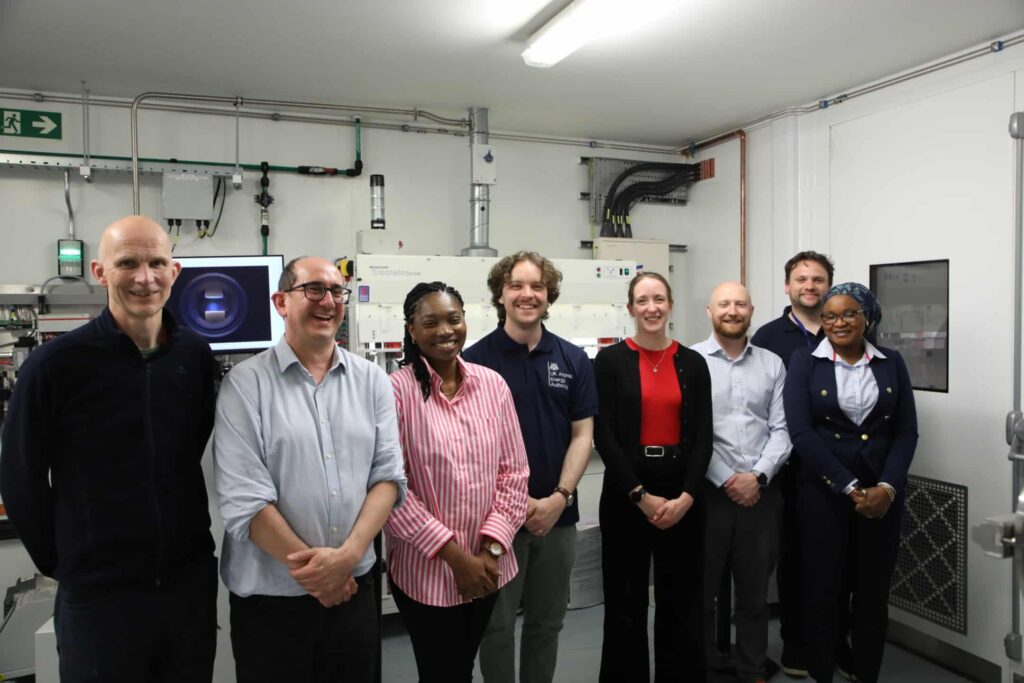
This pioneering project exemplifies the transformative potential of strategic collaboration between academia and industry. By uniting UKAEA’s expertise in fusion energy and advanced engineering with the University of Bristol’s innovative research in materials science, the partnership achieved a world-first innovation. This breakthrough not only demonstrates the value of cross-sector cooperation in solving complex scientific challenges but also highlights how shared knowledge and resources can accelerate the development of technologies with global impact. The success of this initiative underscores the importance of fostering interdisciplinary partnerships to drive innovation, support sustainable energy solutions, and unlock new possibilities.
Looking ahead
Future opportunities include:
- scaling production – increasing battery output and improving power performance
- sustainability gains – reducing reliance on lithium-ion batteries and minimising environmental waste
- versatile power solutions – from watches to satellites, the diamond battery could redefine how we power the future
Read more case studies
-
Diamonds are forever? World-first carbon-14 diamond battery created
How scientists and engineers from the UKAEA and the University of Bristol developed the world’s first carbon-14 diamond battery.
-
Fusion ready steel for a sustainable future
UKAEA and partners are developing fusion-ready steels that are stronger, safer and scalable, helping build the foundations for future fusion power plants.
-
Advancing High Temperature Superconducting integration via Ultrasonic Additive Manufacture
UKAEA and Fabrisonic advanced ultrasonic additive manufacturing to join superconducting tapes, paving the way for compact, high-field fusion magnets.
-
UKAEA viewports support quantum computing at the Technical University of Vienna
UKAEA’s optical viewports supported TU Vienna’s quantum research, enabling single-atom manipulation with clarity, vacuum integrity and reliability.