
The global fusion industry is entering a decade of rapid scale-up. This creates clear and practical routes to market for small and medium-sized enterprises (SMEs) across multiple regions.
Fusion companies are shifting from laboratory prototypes to full demonstration power plants. They increasingly rely on external suppliers rather than building everything in-house. This is creating significant opportunities for SMEs with capabilities in:
- engineering
- manufacturing
- materials
- robotics
- software and digital systems
Organisations often do not need prior fusion experience.
Download our full guide and access the fast-growing global fusion energy sector that is building its supply chain now.
Around 68 private fusion companies across 13 countries are currently developing next-generation fusion devices. Major public programmes support these:
- the International Thermonuclear Experimental Reactor (ITER)
- the UK’s Spherical Tokamak for Energy Production (STEP) programme
- Japan’s planned Japan Demonstration Fusion Power Plant (JA-DEMO)
Private investment now exceeds £10 billion. Global spending on fusion demonstration plants between 2026 to 2035 is expected to rise sharply – over £100 billion in the fusion industry over this timeframe. Maturing fusion firms are beginning to outsource components and systems, keeping only a few complex technologies in-house. The landscape is becoming more open, visible, and navigable for SMEs.
SMEs can engage with the fusion sector through a growing number of practical, low-barrier routes. Many entry points mirror processes used in aerospace, nuclear fission, and advanced manufacturing. This makes them familiar to companies even without prior fusion experience.
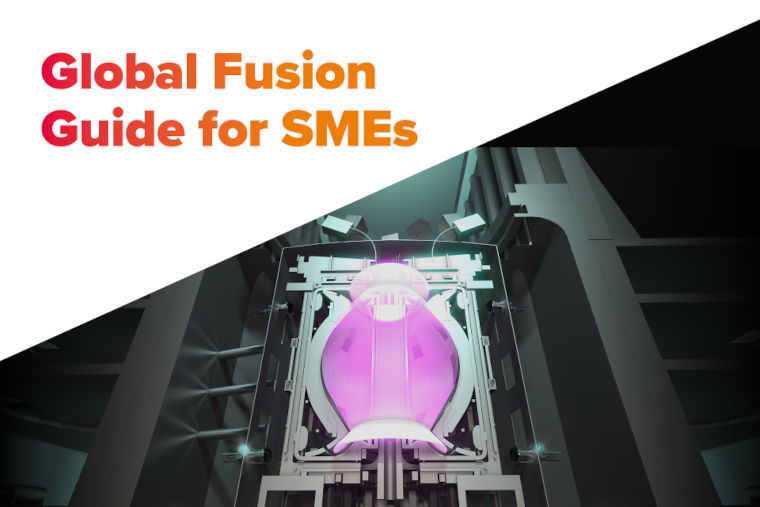
Our guide includes:
- an overview of the fusion technology landscape
- key technologies for fusion power
- global routes to market
- fusion standards and regulations
- other useful information for SMEs
Core engagement pathways
Core engagement pathways include:
- registering on supplier systems
- joining fusion clusters and industry associations to gain visibility, understanding the market, and connecting with developers
- attending supplier days and technical briefings hosted by UKAEA, ITER, and national laboratories to learn about future needs, procurement pipelines, and qualification requirements
- engaging directly with fusion developers – many maintain supplier onboarding programmes and are actively seeking partners in manufacturing, robotics, diagnostics, materials, and digital systems
- engaging with fusion consultancies and large engineering partners to assess product-market fit and understand how best to approach the fusion market
Download our full guide (PDF, 2.5MB) and access the fast-growing global fusion energy sector that is building its supply chain now.